

14 Extraordinary Boring Businesses Making Huge Profits
Table of Contents
-
14 Extraordinary Boring Businesses Making Huge Profits
- Introduction
- Why "Boring" Businesses Often Beat Trendy Startups
- 1. Commercial Waste Management
- 2. Industrial Cleaning Services
- 3. Packaging Manufacturers
- 4. Payroll and Compliance Services
- 5. Elevator and Escalator Maintenance
- 6. Water Treatment Solutions
- 7. Cold Chain Logistics
- 8. Pest Control Services
- 9. Industrial Safety Equipment
- 10. Records and Document Management
- 11. Commercial Laundry Services
- 12. Fire Protection Systems
- 13. Medical Equipment Maintenance
- 14. Business-to-Business Software for Unfashionable Industries
- The Hidden Advantage of Building a "Boring" Business
- Conclusion
Introduction
The world’s most successful businesses aren’t always glamorous. In fact, many of the wealthiest entrepreneurs built fortunes by solving problems that most people ignore.
Ask someone why they want to start a business, and you’ll probably hear the same answers.
Artificial intelligence.
Fintech.
Electric vehicles.
Space technology.
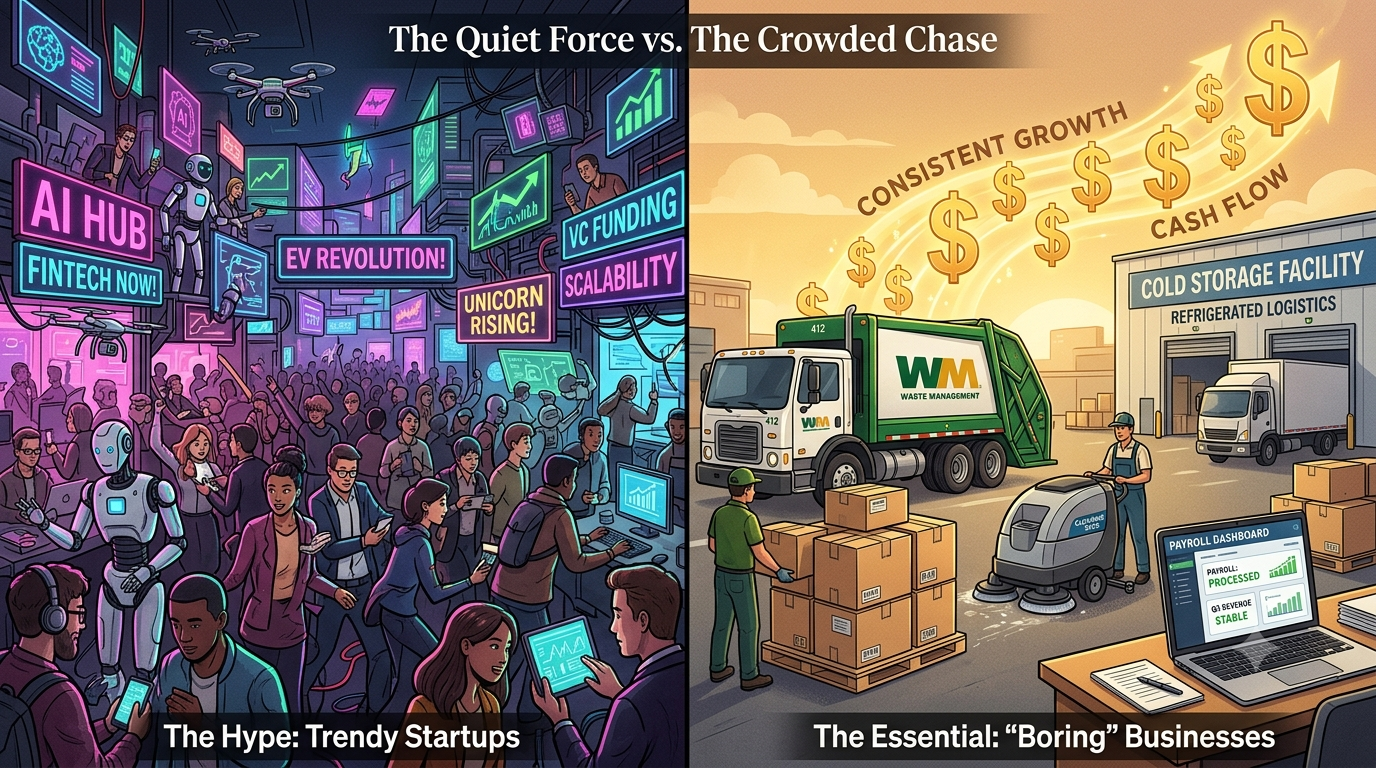
The startup world has become obsessed with building the next disruptive innovation. Investors chase the latest trend, entrepreneurs compete to launch the newest AI application, and social media celebrates founders creating futuristic products.
Yet, hidden behind the headlines is a different reality.
Some of the most profitable companies in the world don’t make viral videos, dominate technology conferences, or generate millions of followers online.
Instead, they clean septic tanks.
Recycle industrial waste.
Supply cardboard boxes.
Maintain elevators.
Manage payroll.
Transport medical supplies.
Manufacture packaging materials.
These businesses are rarely exciting.
But they’re often extraordinarily profitable.
The reason is surprisingly simple.
People may delay buying a new smartphone.
Businesses cannot delay disposing of waste, paying employees, shipping products, or complying with regulations.
Necessities create resilient businesses.
While everyone races toward crowded industries, smart entrepreneurs quietly build companies in markets with predictable demand, loyal customers, and surprisingly high profit margins.
Why “Boring” Businesses Often Beat Trendy Startups
Every year, thousands of startups compete in fashionable industries.
Competition becomes fierce.
Customer acquisition costs increase.
Marketing budgets explode.
Profitability gets pushed further into the future.
Boring businesses operate under completely different economics.
Many serve business customers instead of consumers.
Their services are recurring rather than one-time purchases.
Customer relationships often last years instead of months.
Most importantly, competition remains surprisingly limited because fewer entrepreneurs find these industries exciting.
That’s exactly why they’re attractive.
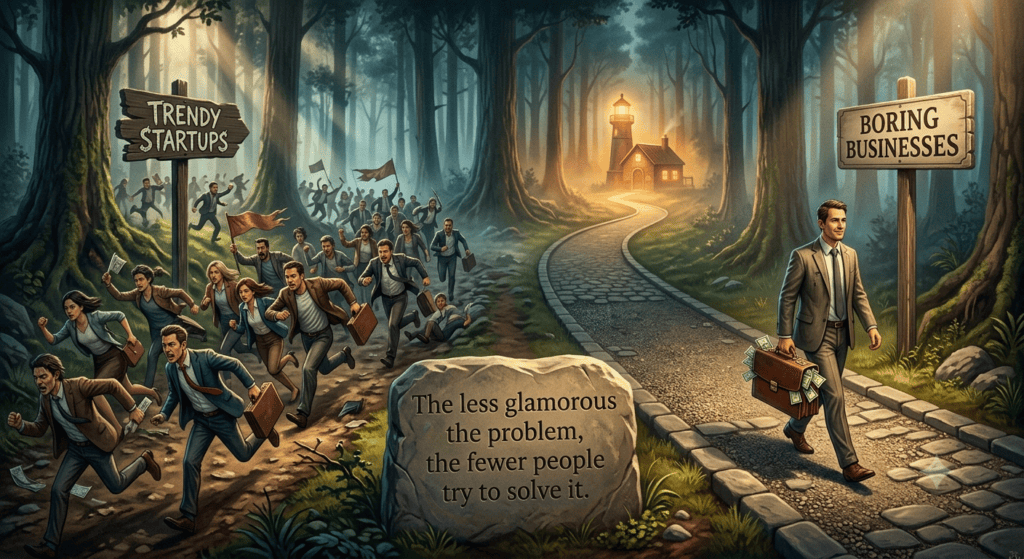
The less glamorous the problem, the fewer people try to solve it.
For founders, that often means stronger pricing power, lower customer acquisition costs, and healthier profit margins.
1. Commercial Waste Management
Waste is one of the few industries guaranteed to exist regardless of economic conditions.
Factories, offices, restaurants, hospitals, and residential communities all generate waste every single day.
Governments continue tightening environmental regulations, creating additional demand for professional waste collection, recycling, and disposal services.
What appears to be a mundane business is actually a recession-resistant industry with recurring contracts and long-term customers.
2. Industrial Cleaning Services
Factories, pharmaceutical plants, warehouses, hospitals, and food manufacturers cannot simply hire ordinary cleaners.
They require specialised industrial cleaning that complies with strict safety and regulatory standards.
Because these services demand expertise, certifications, and specialised equipment, competition remains relatively low while contracts tend to be long term.
Many successful entrepreneurs have quietly built multi-million-dollar businesses serving industries that most people never think about.
3. Packaging Manufacturers
Every online order begins and ends with packaging.
As e-commerce continues expanding, businesses require cardboard boxes, protective materials, labels, custom packaging, and sustainable alternatives.
Consumers rarely notice the companies producing these products.
Yet packaging manufacturers serve thousands of businesses every day, creating stable revenue streams that grow alongside online retail.
4. Payroll and Compliance Services
Every company has employees.
Every employee expects to be paid correctly and on time.
Payroll isn’t exciting, but mistakes are expensive.
Businesses increasingly outsource payroll processing, tax compliance, statutory filings, and HR documentation to specialists who reduce administrative complexity and legal risk.
For founders seeking recurring revenue, few industries are as dependable.
5. Elevator and Escalator Maintenance
Modern cities depend on elevators.
Office towers, shopping malls, apartment complexes, hotels, hospitals, and airports all require routine maintenance to keep elevators operating safely and legally.
Once an installation is complete, maintenance becomes a recurring necessity rather than a one-time sale. Building owners are unlikely to switch providers frequently because reliability matters far more than price.
It’s not a glamorous industry, but it generates predictable, long-term revenue.
6. Water Treatment Solutions
Clean water is no longer just a public utility issue.
Manufacturing plants, hotels, hospitals, residential societies, and commercial buildings increasingly invest in water purification, recycling, and wastewater treatment systems.
As water scarcity and environmental regulations become more pressing, businesses offering filtration equipment, maintenance, and water management services are seeing sustained demand.
It’s a market driven by necessity rather than consumer trends.
7. Cold Chain Logistics
Delivering products is easy.
Keeping them at the correct temperature isn’t.
Pharmaceutical companies, food manufacturers, supermarkets, and vaccine distributors rely on specialised logistics providers that maintain strict temperature controls throughout transportation and storage.
As online grocery services, biologics, and pharmaceutical exports continue to grow, cold chain infrastructure has become one of the most important and profitable, parts of the supply chain.

8. Pest Control Services
Few people dream of building a pest control company.
Yet almost every commercial property needs one.
Restaurants, warehouses, hotels, offices, schools, factories, and residential communities require routine inspections and preventive treatments to comply with health regulations.
The work is repetitive, demand is recurring, and customers typically renew contracts year after year.
That’s exactly the type of business model investors appreciate.
9. Industrial Safety Equipment
Every construction site, factory, warehouse, and manufacturing plant requires helmets, gloves, protective clothing, fire safety equipment, and emergency systems.
Safety regulations ensure demand remains consistent regardless of economic cycles.
As governments strengthen workplace safety standards, businesses supplying industrial safety products continue benefiting from mandatory purchasing requirements rather than discretionary spending.
10. Records and Document Management
Despite digital transformation, millions of businesses still manage physical records.
Banks, hospitals, law firms, insurance companies, and government agencies store enormous volumes of confidential documents that must be securely archived and retrieved when needed.
Companies providing document storage, digital scanning, records management, and secure destruction services operate in a niche with high switching costs and long-term client relationships.
11. Commercial Laundry Services
Hotels.
Hospitals.
Restaurants.
Gyms.
Airlines.
These organisations generate thousands of kilograms of laundry every day.
Instead of investing in expensive facilities, many outsource the work to commercial laundry providers capable of processing large volumes efficiently.
It’s a business built on logistics, operational excellence, and recurring demand rather than marketing hype.
12. Fire Protection Systems
Fire extinguishers, sprinkler systems, smoke detectors, emergency lighting, and fire safety inspections are mandatory for many commercial buildings.
These systems require installation, routine maintenance, testing, and regulatory compliance.
Once again, customers aren’t buying because they want to.
They’re buying because they have to.
That distinction makes the revenue remarkably stable.
13. Medical Equipment Maintenance
Hospitals depend on sophisticated medical equipment.
MRI machines, ventilators, patient monitors, diagnostic devices, and laboratory instruments require regular servicing to remain operational.
Downtime isn’t merely inconvenient, it can affect patient care.
As healthcare infrastructure expands across India and globally, businesses specialising in equipment maintenance are becoming increasingly valuable.
14. Business-to-Business Software for Unfashionable Industries
The most successful software companies don’t always serve consumers.
Many build tools for industries that rarely appear in startup headlines.
Software for waste collection.
Software for fleet management.
Software for warehouses.
Software for manufacturing.
Software for construction companies.
Software for compliance.
These industries may seem ordinary, but they often have fewer competitors, higher switching costs, and customers willing to pay for solutions that improve efficiency.
Some of today’s fastest-growing SaaS companies were built by solving operational problems that most entrepreneurs overlooked.

The Hidden Advantage of Building a “Boring” Business
There’s another reason these businesses quietly outperform trend-driven startups.
They don’t depend on constant attention.
They aren’t competing for social media engagement.
They’re not chasing the latest technology buzzword.
Instead, they focus on solving essential problems that customers encounter every day.
When your business becomes part of a customer’s routine operations, replacing you becomes difficult.
That creates recurring revenue, stronger customer loyalty, and predictable cash flow, three characteristics that often matter more than rapid growth.
Many of these companies also benefit from word-of-mouth referrals, long-term contracts, and low customer churn, reducing the need for expensive advertising campaigns.
In other words, boring businesses often have exciting economics.
Strategic data analyzed by venture capitalists like Tom Tunguz consistently emphasizes that early-stage companies collapse not from a lack of unique ideas, but from a failure to accurately measure operational cash runways and unit economics. For modern business owners operating in a tight capital environment, learning to separate vanity metrics from actual profitabilityas outlined in our comprehensive guide on startup advice and myths, ensures you build a scalable, audit-ready enterprise that stands out to venture capitalist firms and institutional investors alike.
Conclusion
Entrepreneurship isn’t about finding the most exciting industry.
It’s about finding valuable problems that people consistently pay to solve.
While headlines celebrate AI unicorns and billion-dollar technology companies, thousands of entrepreneurs are quietly building wealth through businesses that rarely receive public attention.
Waste management.
Industrial cleaning.
Payroll services.
Packaging.
Cold chain logistics.
Fire protection.
Commercial laundry.
Document management.
These industries may never trend on social media, but they solve essential problems that businesses cannot ignore.
For founders, that’s worth remembering.
Sometimes the biggest opportunities aren’t hidden in futuristic technologies.
They’re hiding inside ordinary industries that everyone else has overlooked.
Faq’s
What are boring businesses?
Boring businesses are companies that operate in essential but less glamorous industries such as waste management, payroll, logistics, packaging, compliance, or industrial services. They often generate stable, recurring revenue.
Why are boring businesses so profitable?
Because they solve everyday operational problems, face less competition, and often secure long-term contracts with businesses that rely on their services.
Are boring businesses good startup ideas?
Yes. Many offer predictable demand, healthy profit margins, and lower customer acquisition costs than trend-driven industries.
Can boring businesses be scaled?
Absolutely. Many expand through franchising, regional expansion, recurring service contracts, technology adoption, and acquisitions.
Which boring businesses have the biggest growth potential?
Waste management, water treatment, industrial software, cold chain logistics, commercial cleaning, compliance services, and specialised B2B SaaS are among the fastest-growing sectors.