


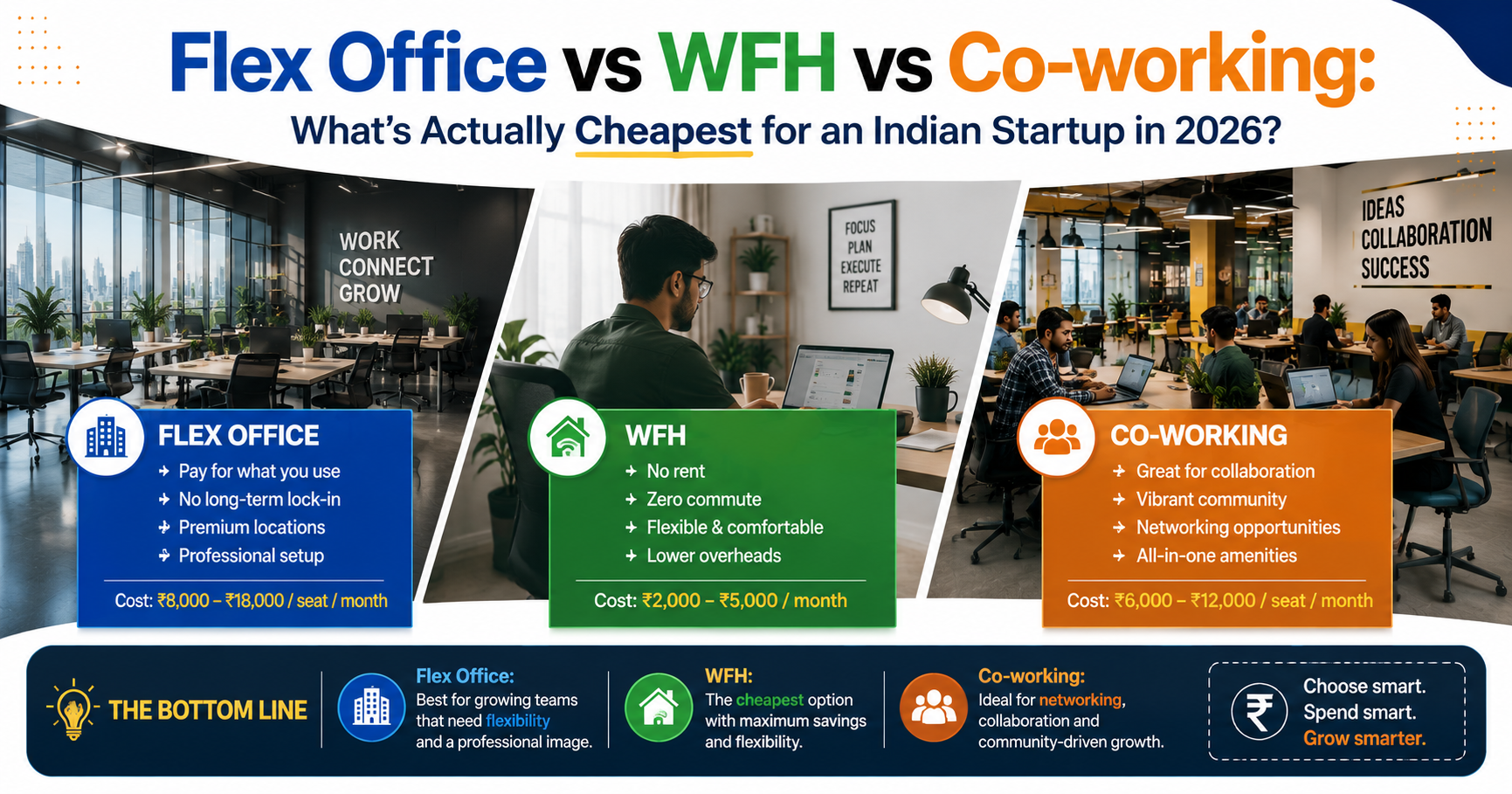
Flex Office vs WFH vs Co-working: What’s Actually Cheapest for an Indian Startup in 2026?
Table of Contents
-
Flex Office vs WFH vs Co-working: What's Actually Cheapest for an Indian Startup in 2026?
- Introduction
- Why Workspace Decisions Matter More Than Ever
- Understanding the Three Workspace Models
- Comparing the Initial Setup Costs
- Looking Beyond Rent: The Hidden Costs
- Productivity Has Financial Value
- Employee Experience Can Influence Long-Term Costs
- Which Workspace Scales Better?
- A Practical Example
- Choosing the Right Model for Different Types of Startups
- Common Mistakes Founders Make
- Key Factors to Evaluate Before Making a Decision
- Conclusion
Introduction
Choosing the right workspace has become one of the most important business decisions for startups in 2026. Not long ago, leasing a traditional office was considered the natural next step after building a small team. Today, however, founders have far more options. Flexible offices, co-working spaces, and work-from-home models have changed the way businesses operate, giving startups the freedom to choose what best fits their budget and growth plans.
For early-stage companies, every expense matters. Office rent, utility bills, internet, furniture, maintenance, and employee travel costs can quickly add up. At the same time, collaboration, productivity, and company culture remain critical for long-term success. The challenge isn’t simply finding the cheapest option—it’s choosing a workspace that supports business growth without creating unnecessary financial pressure.
Many founders assume working from home is always the most affordable solution, while others believe co-working spaces offer the perfect balance between flexibility and professionalism. Flex offices have also gained popularity by providing fully managed workspaces that eliminate many of the responsibilities associated with traditional office leases.
The reality is that no single model works for every startup. The most cost-effective choice depends on your team size, business model, hiring plans, and operational requirements.
In this guide, we’ll compare flex offices, work-from-home setups, and co-working spaces from both a financial and practical perspective, helping Indian startup founders make smarter workspace decisions in 2026.
Why Workspace Decisions Matter More Than Ever
For startups, office expenses are no longer viewed as fixed business costs. They have become strategic investments that influence productivity, hiring, collaboration, and overall financial health.
In today’s competitive environment, founders are expected to manage capital efficiently while creating an environment where teams can perform at their best. Overspending on office infrastructure may reduce the funds available for product development, marketing, or talent acquisition. On the other hand, choosing an inexpensive option that limits collaboration or affects employee satisfaction can slow business growth.
Finding the right balance between cost and functionality has therefore become an important part of building a sustainable startup.
Understanding the Three Workspace Models
Before comparing costs, it’s important to understand how each workspace model operates.
Work From Home (WFH)
Work from home allows employees to perform their responsibilities remotely without commuting to a physical office. Team communication typically relies on digital collaboration tools, video meetings, project management platforms, and cloud-based software.
This model gained widespread acceptance over the past few years and continues to be a popular choice for startups with distributed teams.
Co-working Spaces
Co-working spaces provide businesses with shared office environments where multiple companies work under one roof.
Startups usually rent desks or private cabins while sharing facilities such as meeting rooms, reception services, internet connectivity, cafeterias, security, and common work areas.
The flexible nature of co-working makes it attractive for companies that need professional office space without committing to long-term leases.
Flex Offices
Flex offices are fully managed private office spaces that combine the convenience of serviced offices with flexible rental agreements.
Unlike traditional offices, flex office providers typically handle maintenance, housekeeping, internet, utilities, furniture, security, and facility management, allowing startups to focus entirely on running their business.
This model has become increasingly popular among growing companies that require dedicated office space while avoiding the operational complexities of managing an office independently.
Comparing the Initial Setup Costs
For most startups, the first major consideration is how much money needs to be invested before operations begin.
Work From Home Requires Minimal Initial Investment
At first glance, work from home appears to be the least expensive option because businesses avoid office rent and infrastructure costs.
Employees already have access to their own workspace, and companies only need to invest in collaboration software, laptops, secure internet access, and communication platforms where necessary.
However, as teams expand, businesses often begin offering remote work allowances for internet, ergonomic furniture, electricity, and home office equipment, gradually increasing operational expenses.
Co-working Offers Predictable Monthly Costs
Co-working spaces significantly reduce setup costs because essential infrastructure is already available.
Businesses can begin operations almost immediately without purchasing office furniture or investing in office interiors. Most providers include high-speed internet, meeting rooms, reception services, housekeeping, electricity, and maintenance within the membership fee.
This predictable pricing helps startups manage cash flow more effectively during their early growth stages.
Flex Offices Reduce Capital Expenditure
Flex offices also eliminate many upfront expenses associated with setting up a conventional office.
Instead of spending heavily on interiors, office equipment, security systems, internet installation, and facility management, startups pay a recurring fee for a fully operational workspace.
Although monthly costs may be higher than some co-working memberships, founders often save significant capital by avoiding large one-time investments.
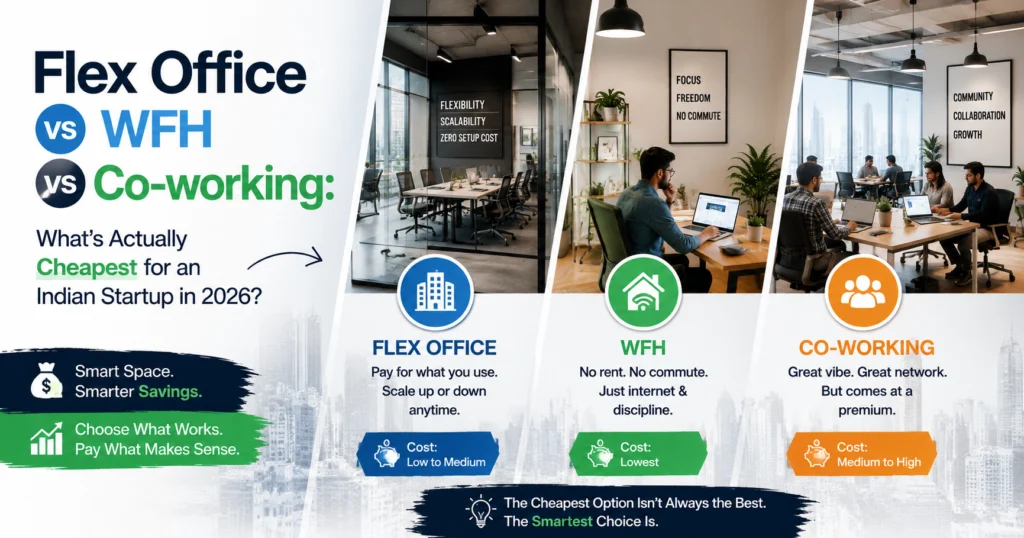
Looking Beyond Rent: The Hidden Costs
Many startups compare workspace options based only on monthly rent. In reality, rent represents only one part of the total cost of running an office.
Utilities, internet services, office maintenance, furniture replacement, cleaning, security, administrative support, meeting facilities, employee commuting, and operational downtime all contribute to the overall expense.
This is why a workspace with a lower rental cost may not always be the most economical option over the long term.
Understanding the total cost of ownership helps founders make decisions based on overall business value rather than headline pricing alone.
Productivity Has Financial Value
Cost savings should never come at the expense of productivity.
A workspace that enables teams to collaborate effectively, solve problems quickly, and communicate efficiently often creates long-term business value that outweighs small monthly savings.
Remote Teams Need Strong Communication Systems
Remote work offers flexibility, but maintaining collaboration requires disciplined communication practices.
Without structured workflows, regular meetings, and effective project management systems, businesses may experience slower decision-making, misunderstandings, and reduced coordination across teams.
Founders considering a fully remote model should invest in processes that maintain accountability while supporting employee engagement.
Office Collaboration Encourages Faster Decision-Making
Co-working spaces and flex offices naturally encourage face-to-face discussions, brainstorming sessions, and spontaneous collaboration.
For startups working on product development, creative campaigns, client servicing, or rapid execution, this level of interaction often leads to quicker problem-solving and stronger team alignment.
The productivity benefits may ultimately offset a portion of the additional workspace costs, particularly for growing businesses.

Employee Experience Can Influence Long-Term Costs
Workspace decisions are not only about rent and infrastructure. They also affect employee satisfaction, productivity, and retention. A workplace that supports collaboration and work-life balance can reduce hiring costs and improve overall business performance.
Work From Home Offers Flexibility but Requires Discipline
Remote work gives employees the freedom to manage their schedules and avoid long commutes. For many startups, this flexibility has become a valuable benefit that helps attract talent from different cities without investing in office space.
However, working remotely also presents challenges. Employees may experience communication gaps, feelings of isolation, or difficulty separating work from personal life. New team members often take longer to understand company culture when interactions happen only through virtual meetings.
To make remote work successful, founders need clear communication processes, regular check-ins, performance tracking, and collaborative digital tools.
Co-working Creates a Professional Environment
Co-working spaces provide startups with a professional office without the responsibilities of managing one.
Employees benefit from dedicated workstations, meeting rooms, networking opportunities, and an environment designed for productivity. For client-facing businesses, inviting customers to a professional workspace can also strengthen credibility.
Another advantage is flexibility. As the team grows or shrinks, businesses can usually adjust their workspace requirements without making long-term commitments.
Flex Offices Support Growing Teams
Flex offices combine privacy with convenience.
Unlike shared co-working environments, businesses receive dedicated office space while continuing to enjoy managed services such as maintenance, internet, reception support, and housekeeping.
This arrangement works particularly well for startups that have reached a stage where confidential meetings, focused collaboration, and stronger brand identity have become priorities.
Which Workspace Scales Better?
Startup growth rarely follows a straight path. Teams expand, new departments are created, and customer demands evolve. The ideal workspace should support these changes without creating unnecessary operational challenges.
Work-from-home models scale quickly because hiring is not limited by geography. Companies can recruit talent from different cities and build distributed teams without increasing office expenses.
Co-working spaces also provide excellent flexibility. Businesses can add or reduce seats according to current requirements, making them suitable for startups experiencing rapid but unpredictable growth.
Flex offices are particularly beneficial for companies entering the next stage of expansion. They offer the stability of a dedicated office while allowing businesses to avoid the long-term commitments associated with traditional commercial leases.
The best option depends on how founders expect their organization to grow over the next few years rather than only considering present-day requirements.
A Practical Example
Consider two technology startups with teams of fifteen employees.
The first startup chooses a fully remote model to reduce operational expenses. Initially, the savings appear significant because there is no office rent or facility management cost. As time passes, however, the company begins providing internet reimbursements, home office allowances, collaboration software subscriptions, and travel expenses for quarterly team meetings. While these costs remain lower than maintaining an office, they become more substantial as the workforce grows.
The second startup operates from a co-working space. Monthly expenses are higher, but employees collaborate more frequently, client meetings become easier to arrange, and new hires adapt more quickly because they work alongside experienced team members. The founders also avoid investing in office furniture, maintenance, security, and administrative support.
Neither company has made the wrong decision. Each workspace aligns with its business priorities. The difference lies in understanding that the cheapest option on paper may not always deliver the greatest long-term value.

Choosing the Right Model for Different Types of Startups
Every startup has unique operational needs, making it important to match the workspace with the business model rather than following market trends.
Early-stage startups with limited budgets often benefit from remote work because it allows them to invest more heavily in product development, customer acquisition, and hiring instead of office infrastructure.
Service-based businesses that regularly meet clients may find co-working spaces more suitable because they offer professional meeting facilities without requiring significant capital investment.
Rapidly growing startups that require dedicated collaboration areas, stronger branding, and greater operational privacy often gain more value from flex offices. These businesses can focus on scaling while leaving facility management to the workspace provider.
Instead of asking which workspace is universally cheaper, founders should ask which option supports their company’s goals over the next two to three years.
Common Mistakes Founders Make
One of the biggest mistakes startups make is selecting a workspace based only on monthly rent. While keeping costs under control is essential, ignoring factors such as employee productivity, collaboration, hiring flexibility, customer perception, and operational efficiency can become expensive in the long run.
Another common mistake is signing long-term office agreements before understanding future business needs. Startups operate in rapidly changing environments, and committing to a workspace that cannot adapt to changing team sizes may create unnecessary financial pressure.
Some founders also overlook hidden operating expenses. Utilities, maintenance, furniture, internet, security, office management, and employee commuting costs can significantly increase the overall cost of running an office. Looking at the complete financial picture leads to more informed decisions.
Finally, many businesses adopt a workspace model simply because competitors are doing the same. Every startup has different priorities, and the most effective workspace strategy is the one that aligns with the company’s stage of growth, team structure, and long-term objectives.
Key Factors to Evaluate Before Making a Decision
Before choosing between work from home, co-working, or a flex office, founders should carefully assess their business requirements instead of focusing only on short-term savings.
Questions such as how frequently teams need to collaborate, whether clients visit the office, how quickly the company expects to grow, and how much operational flexibility is required often provide better guidance than comparing rental costs alone.
Businesses should also evaluate the total cost of ownership, including infrastructure, employee benefits, technology investments, maintenance, and administrative overhead. Considering these factors together helps founders select a workspace that supports sustainable growth while maintaining financial discipline.
Ultimately, the most cost-effective workspace is the one that enables employees to perform at their best, supports business expansion, and allows founders to allocate resources where they create the greatest long-term value.
Conclusion
There is no single answer to the question of whether a flex office, work-from-home setup, or co-working space is the cheapest option for an Indian startup in 2026. The right choice depends on your business model, team size, growth plans, and operational priorities. While cost is an important consideration, it should never be the only factor influencing your decision.
Work from home remains an attractive option for early-stage startups looking to minimize expenses and access talent from different locations. However, as teams grow, businesses may face challenges related to collaboration, communication, and employee engagement. These indirect costs can sometimes outweigh the savings on office rent.
Co-working spaces offer an excellent balance between affordability and professionalism. They provide startups with ready-to-use infrastructure, networking opportunities, and the flexibility to scale without making large upfront investments. For many growing businesses, this model delivers both financial efficiency and operational convenience.
Flex offices, on the other hand, are well suited for startups that require dedicated office space without the long-term commitments of traditional commercial leases. Although the monthly investment may be higher than a co-working membership, the convenience of managed facilities, privacy, and operational support often makes them a worthwhile choice for scaling companies.
Ultimately, the cheapest workspace is not always the one with the lowest monthly bill. It is the one that helps your team work efficiently, supports business growth, strengthens your brand image, and enables you to invest more confidently in the future. By evaluating both direct and indirect costs, founders can choose a workspace that contributes to long-term success rather than simply reducing short-term expenses.

Right choice depends on your business model, team size, growth plans, and operational priorities
Faq’s
Which workspace option is the cheapest for Indian startups in 2026?
For most early-stage startups, a work-from-home model usually involves the lowest initial costs because there is no office rent or infrastructure investment. However, the overall cost depends on factors such as team size, collaboration needs, and employee support expenses.
What is the difference between a flex office and a co-working space?
A co-working space is a shared work environment where multiple businesses use common facilities, while a flex office typically provides a dedicated private office with managed services such as maintenance, internet, security, and housekeeping under flexible lease terms.
Are co-working spaces suitable for small startups?
Yes. Co-working spaces are an excellent choice for startups because they offer professional infrastructure, meeting rooms, high-speed internet, and flexible membership plans without requiring significant upfront investment.
Is work from home still a good option for startups?
Work from home remains a practical option for startups that prioritize cost savings and remote hiring. However, businesses should also invest in communication tools, collaboration processes, and employee engagement to maintain productivity.
When should a startup consider moving to a flex office?
A startup should consider a flex office when its team requires dedicated collaboration space, greater privacy, regular client meetings, or a professional office environment without the long-term commitment of a traditional lease.