


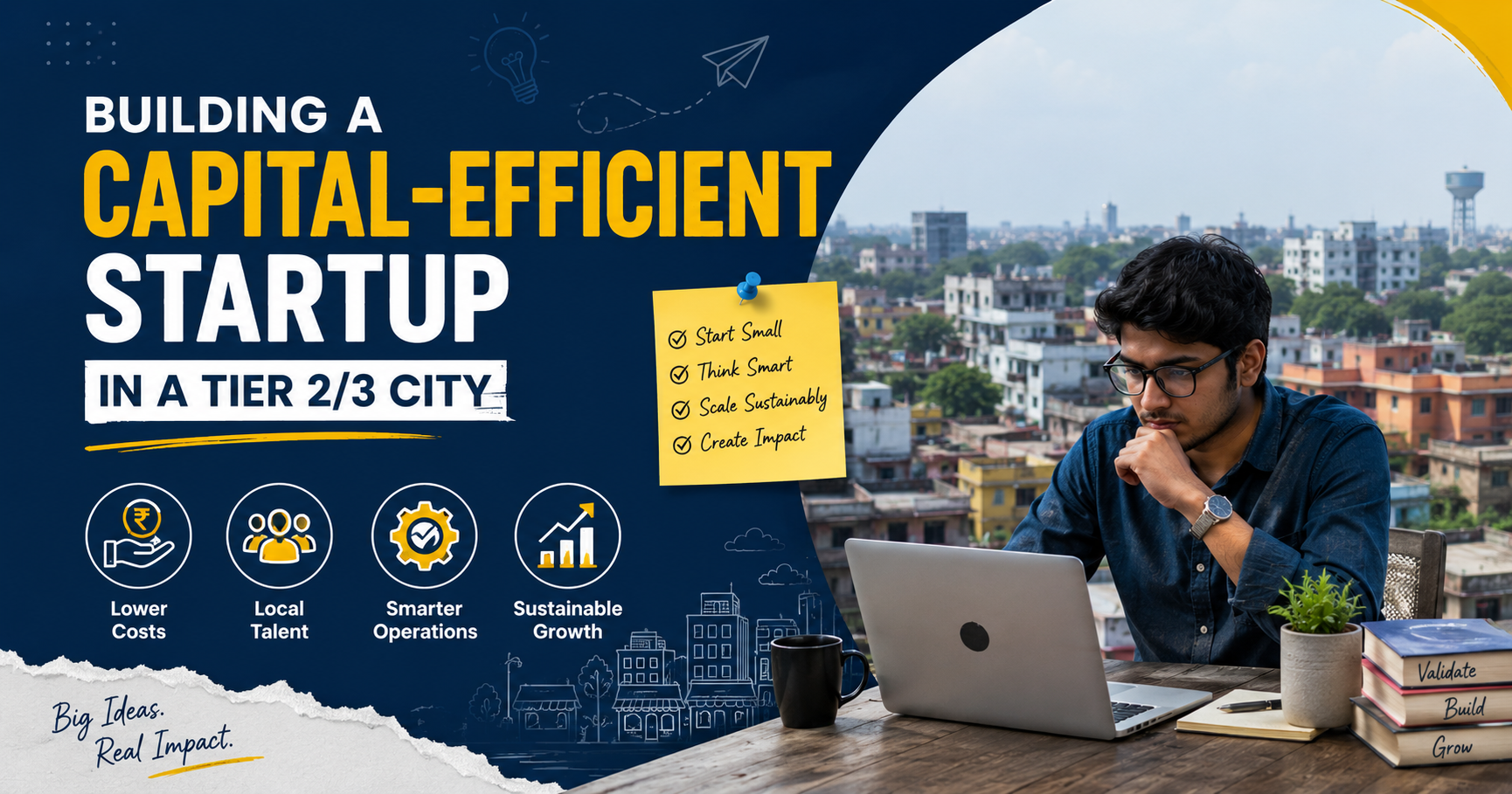
Building a Capital-Efficient Startup in a Tier 2/3 City
Table of Contents
-
Building a Capital-Efficient Startup in a Tier 2/3 City
- Marketing on a Limited Budget
- Manage Cash Flow Carefully
- Avoid Common Financial Mistakes
- Scale Only When Your Business Is Ready
- Invest in Building a Strong Brand
- Measure What Matters
- Build Systems That Can Grow with Your Business
- Why Patience Is a Competitive Advantage
- The Future of Capital-Efficient Startups in India
- Conclusion
Introduction
People imagine a lot of things when they think of startups, such as big office spaces in Bengaluru, Mumbai or Delhi, with investors and multimillion dollar rounds of funding. These stories get the headlines, but they’re by no means the only way to be successful in business.
In India’s Tier 2 and Tier 3 cities, a newfound narrative of startups is developing. Entrepreneurs are creating profitable businesses without expending a ton of money. Rather than pursuing growth for the sake of growth, they are taking a more measured approach to growth, smart investments and addressing issues in the community.
Creating a startup that’s capital efficient does not mean that you have to scale down your dreams. It’s about how you utilize your available resources, creating value before you rush off and spend big, and building a business which can grow organically, with less dependence on external capital.
This is a great benefit for startups in lesser urban areas. Reducing expenses, hiring local talent and improving digital infrastructure allow for the development of successful companies without the high costs. This guide delves into the ways that the founders can leverage these opportunities to establish financially disciplined businesses that can be long-term.
What is meant by a capital efficient startup?
A capital efficient startup is one that will get the most out of their resources without spending unnecessary resources. These businesses make use of their resources well and minimize their investments in the capital, rather than putting their trust in the investors.
Capital efficiency is not at all about spending the least. It’s all about making sure that every rupee spent goes towards the business expansion, customer satisfaction, or streamlining operations for the company.
Successful businesses started out by focusing and controlling the resources that they had. They founded their businesses on the premise of testing their ideas, learning more about their customers, and establishing their business model before expanding.
Why Tier 2 & Tier 3 Cities provide a competitive advantage
Lower Operational Costs
Some of the most significant benefits of starting a startup outside the big cities is being inexpensive. The cost of renting office space is much lower, employee salaries are lower and costs of daily operation are lower than in metro cities.
This cost benefit enables the founders to allocate more resources towards product development, marketing and customer acquisition, instead of the majority of their budget on overheads.
The cost savings also ease the strain on cash flow in the initial stages, when income can be still rising.
Better Runway for Startups
All startups have a “runway”—how long they can continue running their business before they need more capital.
Expenses are relatively lower in Tier 2 & Tier 3 cities and this helps startups to have a long runway. This allows for founders to have more time to make improvements to their products, get customers and become profitable before entering into a process of fundraising.
Be sure to begin with Solving One Clear Problem
Most business owners don’t succeed because they attempt to address too many issues. Capital efficient startups start with one clear problem with customers that really want solved.
Take the time to see your local area. Explain to a business, a family, students, a health care worker, retailer, or farmer. The challenges they face on a day-to-day basis can sometimes present some really great possibilities that have not been considered in bigger firms.
Don’t create a complex product right away, but instead create a simple solution that will provide value right away. Customers will use it from the start and it will be used to improve in the future.
Any business that is able to take action to solve actual problems will grow naturally, as happy customers are its best marketing agents.
Avoid sinking a lot of capital into an idea you haven’t already tested
Create Minimum Viable Product (MVP)
Creating a Minimum Viable Product (MVP) is one of the cleverest ways to save money, and it will ultimately help you build a successful business.
An MVP is just the minimum amount of features that are required, to fix the main problem of the customer. This will enable founders to check market demand without committing a lot of time and money.
A startup could, for instance, create a straightforward website or a WhatsApp service to determine what users are interested in rather than creating a complicated mobile application with a lot of functions.
The information collected during this step can help to avoid costly errors later on.
Listen More Than You Sell
Early customers can give you the best feedback for your business.
Instead of concentrating on sales, take the time to learn about how your product is being used, problems they encounter, and desired enhancements.
Conversations influence future product development and help to ensure investments are made, based on customer needs and not assumptions.

Build a Lean Team
One of the biggest budget issues that startups typically face is having too many employees too early.
Don’t create a big staff right away, start with a small group of multi-talented staff members who can take on a variety of tasks.
In smaller cities, people who have talent appreciate more the position they have, the opportunity to advance and good work-life balance than high pay. This gives room to recruit quality staff without facing competition with the metropolitan salary scales.
Grow the business slowly and gradually as revenues grow according to requirement of the business and not according to future projections.
Reduce costs using Technology
Start-ups can make use of technology to run their operations efficiently without having to put in a lot of investment into constructing physical infrastructure.
Cloud based software can help to handle accounting, customer relationships, inventory, communication, project management and marketing, all for a fraction of the cost of the traditional software.
Automation also minimizes repetitive tasks, enabling a smaller number of people to achieve more, using fewer resources along the way.
Many startups start with low-cost monthly software tools, or subscriptions, which can grow with the company, instead of having to buy costly software licenses.
Build Revenue Early
Lots of startups take several months, sometimes even a number of years, to refine their product before they even try to make any money. For a venture-backed business, it can be a good strategy, but can be costly for a business that is bootstrapped.
Earning early revenue is a good sign of a successful business idea and helps to boost your cash flow. Customer feedback is important to any company, and it’s not just about large sales, it’s about any sales.
Don’t strive for perfection, concentrate on providing a solid value and enhancing what you have over time.
If your company starts making money early, they make better financial decisions– because of the demand of your customers.
Focus on Customer Retention Instead of Constant Customer Acquisition
Acquiring a new customer usually costs far more than retaining an existing one. That’s why capital-efficient startups pay close attention to customer satisfaction.
Providing excellent service, responding quickly to customer concerns, and consistently delivering quality products encourage repeat business and referrals.
Satisfied customers naturally recommend businesses they trust, reducing marketing expenses while increasing long-term profitability.
In smaller cities, where communities are closely connected, positive customer experiences often spread quickly through word-of-mouth, making retention one of the most cost-effective growth strategies available.
Build Strategic Local Partnerships
Every startup doesn’t have to grow alone.
Partnering with local businesses, educational institutions, industry associations, and community organizations can create valuable opportunities without requiring significant financial investment.
For example, a technology startup might collaborate with local colleges for internships, while a retail business could partner with nearby suppliers to reduce logistics costs. Healthcare startups may work with local clinics, and education companies can collaborate with schools to expand their reach.
Strong partnerships help businesses build credibility, access new customers, and share resources that would otherwise require substantial investment.
Smart Funding Strategies for Sustainable Growth
Bootstrap Whenever Possible
Bootstrapping simply means building your business using your own resources and the revenue you generate instead of relying entirely on outside investment. This approach encourages disciplined spending and forces entrepreneurs to prioritize activities that directly contribute to growth.
While raising funds can accelerate expansion, it also brings greater expectations and accountability. Many successful startups from Tier 2 and Tier 3 cities have proven that sustainable businesses can be built by growing steadily and reinvesting profits.
Explore Government Schemes and Startup Programs
India has introduced several initiatives to encourage entrepreneurship beyond metropolitan cities. Startup incubators, state innovation missions, MSME support programs, and startup competitions provide funding, mentorship, networking opportunities, and business guidance.
Instead of depending solely on venture capital, founders should actively explore these resources. They often provide valuable support while allowing entrepreneurs to retain greater ownership of their businesses.

Marketing on a Limited Budget
A limited marketing budget should never limit your visibility. Many successful startups have built strong brands through consistency, creativity, and genuine customer relationships rather than expensive advertising.
Content marketing, search engine optimization (SEO), Google Business Profile, email marketing, social media engagement, and customer referrals can all generate long-term results without requiring significant financial investment.
Sharing customer success stories, educational content, behind-the-scenes updates, and practical tips helps establish credibility while building trust with potential customers.
Let Your Customers Become Your Brand Ambassadors
Happy customers often become the most effective marketers.
Encourage satisfied clients to leave online reviews, share testimonials, and recommend your business to friends and colleagues. In Tier 2 and Tier 3 cities, where communities are closely connected, positive recommendations spread quickly and often influence purchasing decisions more than paid advertisements.
Building trust takes time, but once earned, it becomes one of the strongest competitive advantages any startup can have.
Manage Cash Flow Carefully
Profit and cash flow are not the same. A business may appear profitable on paper while struggling to pay its day-to-day expenses due to poor cash management.
Monitor your income and expenses regularly. Avoid unnecessary purchases, negotiate better payment terms with suppliers, and ensure customers pay invoices on time.
Maintaining healthy cash flow allows your startup to handle unexpected expenses without disrupting operations or delaying future growth.
Founders who develop strong financial discipline early usually make better strategic decisions as their businesses expand
Avoid Common Financial Mistakes
Many startups fail not because their ideas are weak but because they make avoidable financial mistakes during their early stages.
Avoiding these mistakes helps preserve valuable capital while improving the chances of long-term success.
Scale Only When Your Business Is Ready
Growth is exciting, but expanding too quickly can create unnecessary financial pressure.
Before entering new markets or launching additional products, ensure your existing operations are stable. Consistent revenue, satisfied customers, efficient processes, and a reliable team are all signs that your business is ready for the next stage.
Scaling gradually allows entrepreneurs to maintain quality while reducing the risks associated with rapid expansion.
A business that grows steadily often becomes stronger than one that expands faster than its resources allow.
Invest in Building a Strong Brand
A recognizable brand can reduce customer acquisition costs over time because people naturally trust businesses they remember.
Brand building goes beyond designing a professional logo. It includes your customer service, communication style, product quality, online presence, and the overall experience customers have with your company.
When customers associate your brand with reliability and value, they are more likely to return and recommend your business to others.
Strong branding becomes particularly valuable in competitive markets where products may appear similar but customer experiences differ significantly.
Measure What Matters
Successful entrepreneurs rely on data rather than assumptions.
Track important business metrics such as monthly revenue, customer acquisition cost, customer retention rate, profit margins, conversion rates, and customer lifetime value.
Monitoring these numbers helps identify opportunities for improvement before small issues become larger problems.
Rather than chasing vanity metrics like social media followers, focus on measurements that directly influence profitability and sustainable growth.

Build Systems That Can Grow with Your Business
Many founders spend so much time working in their business that they forget to build systems that allow the business to operate efficiently.
Document workflows, automate repetitive tasks, and create clear processes for customer service, sales, inventory management, and finance.
Well-designed systems reduce dependency on individual employees and make future expansion much easier.
Businesses with organized operations often scale faster because they spend less time solving recurring problems.
Why Patience Is a Competitive Advantage
Modern startup culture often celebrates rapid growth and overnight success. In reality, most successful businesses grow steadily over several years.
Founders in Tier 2 and Tier 3 cities have the opportunity to focus on long-term sustainability instead of short-term hype. Lower operating costs and closer customer relationships allow them to improve gradually while building a financially stable company.
Patience also creates room for thoughtful decision-making. Instead of reacting to every market trend, entrepreneurs can focus on building products and services that continue delivering value over time.
The Future of Capital-Efficient Startups in India
India’s entrepreneurial landscape is becoming increasingly decentralized. Smaller cities now have access to better internet connectivity, digital payment systems, startup incubators, skilled graduates, and expanding customer markets.
Investors are also recognizing that some of the country’s most innovative businesses are emerging from regions beyond traditional startup hubs.
As technology continues to reduce geographical barriers, entrepreneurs in Tier 2 and Tier 3 cities will have even greater opportunities to compete nationally and globally while maintaining lean and sustainable operations.
Businesses that combine financial discipline with customer-focused innovation are likely to define the next generation of successful Indian startups.
Conclusion
Building a capital-efficient startup isn’t about limiting your ambitions—it’s about making smarter decisions with the resources you have. Entrepreneurs in Tier 2 and Tier 3 cities are uniquely positioned to build sustainable businesses thanks to lower operating costs, growing digital infrastructure, and a deeper understanding of local markets.
Success doesn’t depend on raising the largest investment or opening the biggest office. It comes from solving meaningful problems, managing finances wisely, building strong customer relationships, and growing at a pace your business can sustain.
As India’s startup ecosystem continues to evolve, founders who embrace capital efficiency will be better equipped to navigate uncertainty, seize new opportunities, and create businesses that stand the test of time.

Start Your Startup Journey Today! Discover more actionable tips on building a capital-efficient startup, scaling your business in Tier 2/3 cities, and achieving sustainable growth—all in our latest startup guides.
Faq’s
What is a capital-efficient startup?
A capital-efficient startup focuses on achieving sustainable growth while minimizing unnecessary spending. It prioritizes smart financial management, early revenue generation, and efficient use of available resources.
Why are Tier 2 and Tier 3 cities ideal for capital-efficient startups?
These cities offer lower operating costs, affordable office space, access to skilled talent, reduced competition, and growing consumer markets, making it easier to build profitable businesses with limited capital.
Can I build a successful startup without raising venture capital?
Yes. Many successful businesses begin by bootstrapping, generating early revenue, and reinvesting profits before seeking external investment.
How can startups reduce operational costs?
Using cloud-based software, remote work, automation, lean hiring, strategic partnerships, and careful financial planning can significantly reduce expenses.
What industries perform well in smaller cities?
Technology services, healthcare, education, retail, logistics, agriculture, manufacturing, digital marketing, and home improvement businesses have shown strong growth potential.
How important is customer retention for capital-efficient startups?
Customer retention is crucial because retaining existing customers costs less than acquiring new ones. Loyal customers also generate referrals and recurring revenue.
When should a startup begin scaling?
A startup should scale only after achieving consistent revenue, validating its business model, establishing efficient operations, and maintaining healthy cash flow.